
Hydraulic vs electric power steering replacement decisions come down to understanding how each system works, what typically fails, and what you'll actually pay to fix it.
Every week at Local Car Repair Shop, we guide customers through these exact choices, and the right answer depends on your car's age, your budget, and how long you plan to keep the vehicle.
This guide walks you through both systems honestly. No technical jargon meant to impress just practical information that helps you make a confident decision when steering problems appear.
How Power Steering Actually Works
Before comparing replacement costs, you need to understand what's happening when you turn the wheel. Both systems do the same job making steering light enough that parking doesn't require a workout but they go about it completely differently.
Hydraulic Power Steering: The Old Reliable
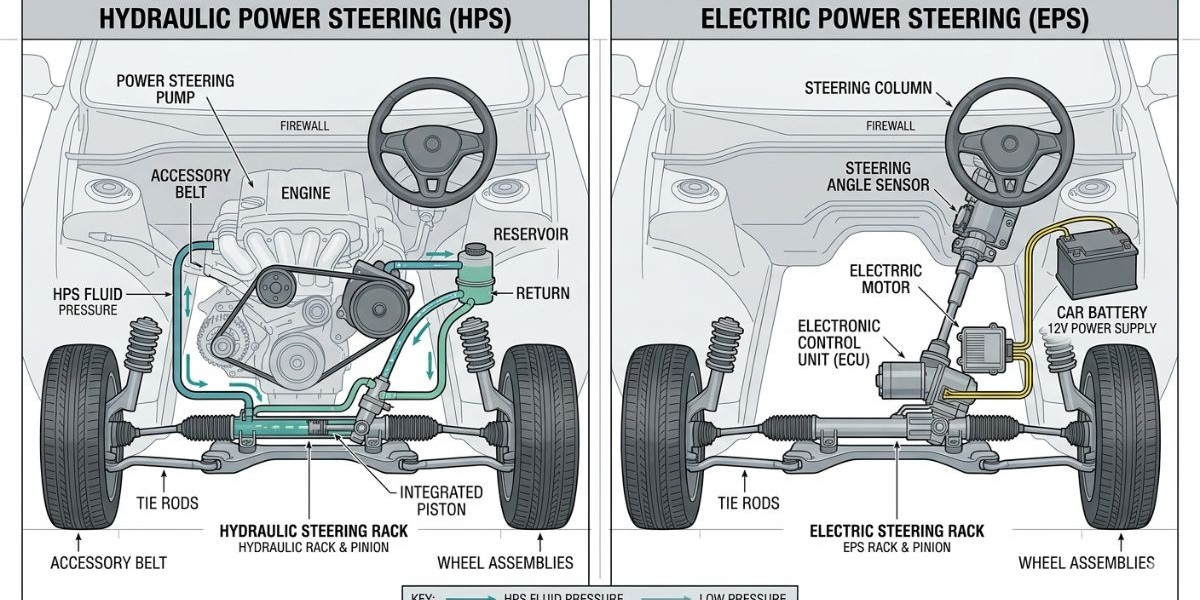
Hydraulic systems have been around for decades. A belt driven by your engine spins a pump that pressurises steering fluid. When you turn the wheel, valves direct that pressurised fluid into a piston inside the steering rack, which pushes the wheels in the direction you want.
The result is that satisfying weighted feel that older car enthusiasts love. You feel connected to the road through the steering wheel, with natural resistance that builds as you turn harder.
The trade-off? The pump runs constantly, even when you're driving straight. That drag on the engine costs you a small amount of fuel economy.
You also need to check fluid levels and watch for leaks, because hydraulic systems rely on sealed hoses and connections that eventually wear out.
Electric Power Steering: Modern and Clever
Electric systems ditch the fluid and pump entirely. An electric motor mounted on the steering column or rack provides assistance based on what sensors tell it about your speed and how much you're turning.
This setup only uses power when you actually need assistance. No constant drag means slightly better fuel economy, typically 2-3% improvement over hydraulic systems.
The clever part? Electric steering can adjust itself. At parking speeds, it gives you maximum assistance so the wheel turns effortlessly.
At motorway speeds, it firms up naturally so the car feels stable and you don't accidentally overcorrect. Modern cars integrate this with lane-keeping assist and self-parking features.
The downside is cost when things break. Electric systems pack sensitive electronics into places that get hot, vibrate, and live under the car. When they fail, replacement parts cost more.
Spotting Problems Before They Strand You
Both systems give warning signs before complete failure. Knowing what to listen and feel for saves you from being caught out.
Hydraulic System Warning Signs
Whining when turning is the classic symptom. That groaning noise means the pump is struggling, usually because fluid is low or the pump itself is wearing out. Check fluid level first if it's dark or smells burnt, the system needs attention.
Heavy steering that comes and goes suggests the pump is failing intermittently. Sometimes it works, sometimes it doesn't. This won't fix itself.
Visible fluid leaks under the car, especially near the front wheels or dripping from behind the engine. Hydraulic fluid has a distinct smell like burnt marshmallow and leaves oily patches on your driveway.
Steering feels jerky or uneven when turning. Air in the system from a leak causes inconsistent assistance.
Electric System Warning Signs
Warning lights on the dashboard often appear before you notice steering changes. Modern cars detect electrical faults early.
Steering suddenly feels heavy and stays heavy. If the motor or controller fails completely, you lose all assistance. The car remains steerable but feels like an old car without power steering.
Intermittent assistance where steering works fine sometimes and goes heavy other times points to electrical gremlins loose connections, failing sensors, or controllers overheating.
Steering pulls to one side or feels inconsistent through corners. Electric systems can develop faults that affect only certain driving situations.
Clunking or knocking from the steering column area suggests mechanical wear in the motor mounting or column joints.
What Actually Breaks in Each System
Understanding failure points helps you judge whether repair or replacement makes sense.
Hydraulic Failure Points
The pump wears out eventually. Bearings fail, internal seals leak, and pressure drops. Pumps typically last 100,000-150,000 miles but fail earlier if fluid wasn't changed regularly.
Hoses and pipes corrode or split, especially in UK road salt conditions. A leaking hose loses fluid quickly, and if you drive without fluid, the pump destroys itself within minutes.
The steering rack seals leak internally or externally. Internal leaks mean fluid bypasses the piston, reducing assistance. External leaks leave puddles.
The drive belt snaps or slips. Without the belt turning the pump, you have no assistance at all.
Electric Failure Points
The electric motor brushes wear out or windings fail. Unlike hydraulic pumps, you can't usually rebuild these; replacement is the only option.
Torque sensors tell the system how hard you're turning. When they fail, the car doesn't know how much assistance to give, resulting in weird steering behaviour.
The control module (computer) fails from heat, vibration, or water ingress. This is the brain of the system, and replacement often requires programming by a specialist.
Wiring and connectors corrode, especially on cars driven through floods or salty winters. Intermittent faults trace back to bad connections surprisingly often.
The entire steering rack on some modern cars integrates the motor and controller into one sealed unit. If any part fails, you replace the whole assembly at significant cost.
Real Replacement Costs in the UK
Let's talk about money. These figures represent typical UK garage prices including parts and labour.
Hydraulic System Costs
Repair Type | Typical Cost Range | Notes |
Fluid flush and top-up | £50-£90 | Essential maintenance every 2-3 years |
Hose replacement | £150-£350 | Depends on which hose and accessibility |
Pump replacement | £250-£550 | Genuine pumps cost more but last longer |
Steering rack replacement | £400-£800 | Labour-intensive job |
Complete system overhaul | £700-£1,200 | Pump, rack, hoses all at once |
Hydraulic repairs spread across components. You might replace just a hose today and the pump next year, spreading costs.
Electric System Costs
Repair Type | Typical Cost Range | Notes |
Diagnostic scan | £60-£120 | Essential to pinpoint exact fault |
Torque sensor replacement | £200-£400 | Sometimes possible separately |
Motor replacement | £400-£800 | If available separately from rack |
Control module replacement | £350-£700 | Usually needs programming |
Complete EPS rack | £800-£1,800 | Most common outcome for major faults |
Column-mounted motor | £500-£1,200 | On systems where motor is on column |
Electric repairs often end up at the higher end because components integrate so tightly. A failed sensor inside the rack might mean replacing the whole rack if the manufacturer doesn't supply the sensor separately.
Repair Vs Replacement: Making the Call
Not every fault needs a full system replacement. Here's how we guide customers through this decision at Local Car Repair Shop.
When to Repair
Hydraulic systems respond well to repairs when the problem is isolated. A leaking hose gets replaced. A noisy pump gets swapped. The rest of the system carries on. Because hydraulic parts are modular, you can fix one thing at a time.
Electric systems sometimes allow component-level fixes. Sensors, wiring repairs, and occasionally motors can be replaced independently. This depends entirely on your car some manufacturers design for repairability, others don't.
When to Replace
Hydraulic systems reach replacement territory when multiple components fail simultaneously. A leaking rack, worn pump, and perished hoses together cost more to fix piecemeal than replacing everything at once.
Electric systems often force replacement when the fault lies inside a sealed unit. If the motor is built into the rack and cannot be separated, replacement is your only option regardless of which part actually failed.
Age matters too. A fifteen-year-old car with 150,000 miles might not justify expensive repairs. A five-year-old car you plan to keep another five years probably does.
Steering Feel: Why Some Drivers Care
Here's something replacement guides rarely mention: steering feel matters to some drivers, and the two systems feel completely different.
Hydraulic steering provides natural weight and feedback. You feel the road through the wheel texture changes, camber shifts, the front wheels gripping or slipping. Enthusiasts often prefer this connected sensation.
Electric steering feels artificially damped by comparison. Modern systems replicate feel through software, and while they've improved massively, they still can't quite match the organic feedback of hydraulics.
If you're the type of driver who notices and cares about steering feel, you might prefer to keep a hydraulic car running rather than switch to something newer with electric steering. That's a valid reason to invest in repairs rather than replace the car.
Which System Is More Reliable Long-Term
The reliability question divides opinion.
Hydraulic systems are mechanically simple and proven over decades. When maintained properly fluid changes every few years, prompt leak repairs they last indefinitely. The pump might need replacement at 150,000 miles, but the core system keeps working.
Electric systems have fewer moving parts but more complexity. No fluid, no pump, no hoses to leak. But electronics fail differently sometimes suddenly, sometimes intermittently, and often expensively.
Our workshop data suggests hydraulic systems fail gradually, giving warning. Electric systems sometimes fail without notice, though warning lights usually appear first.
For long-term ownership, well-maintained hydraulic systems edge ahead on pure reliability. But electric systems require less day-to-day attention and offer features you can't get with hydraulics.
What Modern Cars Use and Why
Nearly all new cars now use electric power steering. Manufacturers switched for several reasons:
Fuel economy regulations forced every efficiency gain possible. Electric steering contributes a small but meaningful improvement.
Self-driving features need electronic control. Lane-keeping, parking assist, and autonomous driving all require steering that computers can command. Hydraulic systems can't integrate this way.
Manufacturing simplicity matters. Building cars without pumps, hoses, and fluid reservoirs simplifies assembly and reduces parts inventory.
Weight saving helps meet emissions targets. Electric systems weigh less than hydraulic equivalents.
This means hydraulic systems increasingly belong to older cars. If you drive something from before roughly 2010, you likely have hydraulic steering. Cars from 2015 onward are almost certainly electric.
Making Your Decision: Questions to Ask
When faced with steering problems, work through these questions:
How old is the car? Older cars suit cost-effective repairs rather than expensive replacements.
How long will you keep it? If you're selling soon, the cheapest functional fix makes sense. If keeping it, invest properly.
What exactly failed? One hose or the whole rack? Get a specific diagnosis before deciding.
Can you get parts? Some older hydraulic parts become scarce. Electric parts for newer cars remain available.
Do you care about steering feel? If yes, keeping a hydraulic car going might matter more than raw economics.
What's the total cost versus car value? A £1,200 repair on a £2,000 car feels different than on a £10,000 car.
Preventing Steering Problems
Whichever system your car uses, prevention beats cure.
For hydraulic systems: Check fluid monthly. Look for leaks underneath. Listen for unusual noises. Change fluid every two to three years. Fix small leaks before they become big ones.
For electric systems: Keep battery health good, low voltage stresses electric steering components. Avoid kerbing wheels hard, which shocks the whole system. Address warning lights promptly rather than resetting and hoping.
For both: Regular servicing catches problems early. A mechanic checking suspension and steering components during routine work spots worn parts before they fail completely.
Final Verdict
Hydraulic vs electric power steering replacement isn't a question with one right answer. It depends entirely on your car, your budget, and what matters to you as a driver.
Hydraulic systems reward maintenance with long life and pleasant steering feel. They're generally cheaper to repair piece by piece. But they're disappearing from new cars, and parts availability for older vehicles will eventually become an issue.
Electric systems offer modern features, better efficiency, and less daily fuss. But when they fail, repairs cost more and sometimes force complete replacement of integrated units.
Local Car Repair Shop sees both systems every day. We repair hydraulic leaks on twenty-year-old classics and replace electric racks on five-year-old family hatchbacks.
Neither system is inherently better; they're just different solutions to the same problem, designed for different eras with different priorities.
The smart approach? Understand what your car has, maintain it properly, and when problems appear, get a proper diagnosis before deciding on repair versus replacement.
That way, you make decisions based on facts rather than fear, and your steering keeps working exactly as it should for years to come.