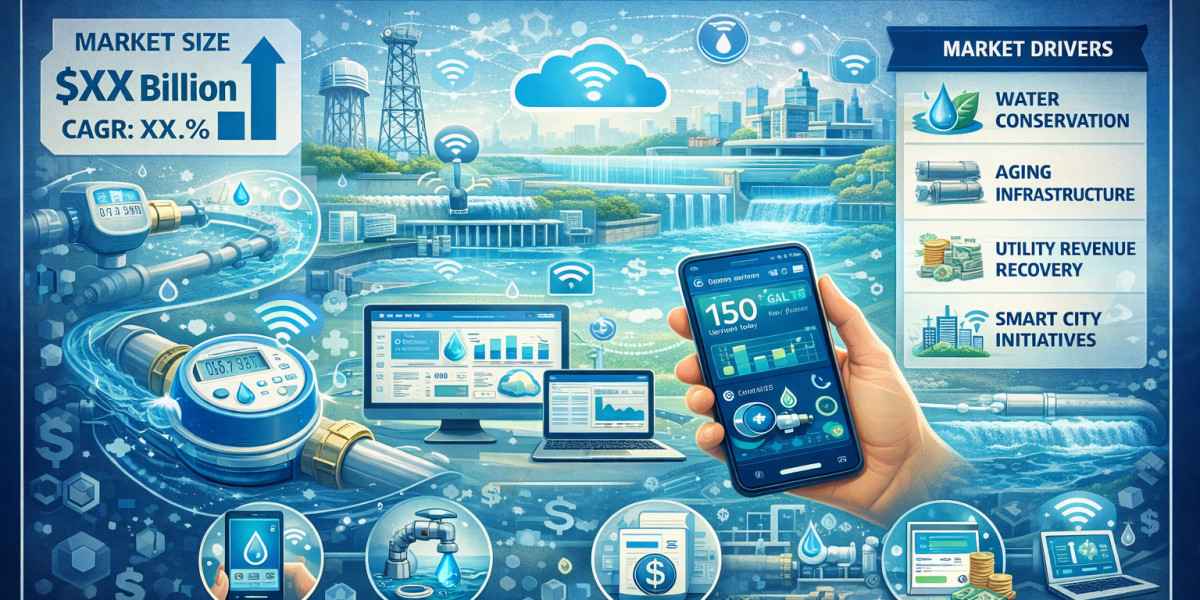

The global smart water metering market is on a strong growth trajectory, projected to expand from US$ 3.80 billion in 2023 to US$ 7.36 billion by 2031, registering a compound annual growth rate (CAGR) of 9.9% during the 2023–2031 forecast period. According to a published research report by The Insight Partners, this robust expansion is being driven by the intensifying global focus on water conservation and loss reduction, the accelerating rollout of smart city initiatives across both developed and developing economies, and the growing adoption of IoT-enabled metering technologies that give water utilities and end users unprecedented real-time visibility into water consumption patterns, leakage events, and distribution inefficiencies. As water scarcity challenges mount globally and municipalities face increasing pressure to stretch existing water infrastructure further while reducing nonrevenue water losses, smart metering has emerged as a strategically essential tool for sustainable water management.
Get the sample request - https://www.theinsightpartners.com/sample/TIPTE100000347
Understanding Smart Water Metering
Smart water meters are advanced measurement devices equipped with IoT sensors, communication modules, and data processing capabilities that continuously track water consumption and transmit usage data to utilities and consumers in real time or near-real time. Unlike conventional mechanical meters that require manual reading on a periodic basis, smart water meters generate granular, time-stamped consumption data — typically recording usage on an hourly or even more frequent basis — that enables utilities to detect leaks, identify tampering or illegal connections, generate accurate bills, and build detailed profiles of demand patterns across their distribution networks.
The intelligence layer that distinguishes smart from conventional meters encompasses two primary communication architectures. Automatic Meter Reading (AMR) systems transmit data one-way from meter to utility, primarily automating the data collection process to eliminate manual reads. Advanced Metering Infrastructure (AMI) systems represent a more sophisticated evolution — supporting two-way communication between meters and the utility's operational systems, enabling remote configuration, real-time alerts, demand response signaling, and integration with broader smart grid and smart city data platforms. This two-way connectivity transforms the smart water meter from a passive measurement device into an active node in a connected water management network.
Key Market Drivers
The primary driver of smart water metering market growth is the urgent and growing need to monitor, control, and reduce nonrevenue water — the gap between the volume of water produced and the volume successfully billed to customers. Global water losses through leakage, metering errors, unauthorized connections, and billing inefficiencies represent a staggering economic and resource challenge. Research by the International Water Association estimates global water waste in distribution networks at approximately 346 million cubic meters per day — equivalent to around 126 billion cubic meters annually — representing losses that amount to roughly US$ 39 billion per year in North America alone. Water theft and illegal tapping account for an estimated 8% of nonrevenue water in North America on an annual basis. Smart water meters directly address this challenge by recording hourly data on leakage events — including the precise time and location of occurrence — enabling rapid detection and response, while built-in alarm systems help identify and deter pipeline tampering and unauthorized connections. The compelling economic case for nonrevenue water reduction is driving utilities globally to invest in smart metering infrastructure as a financially self-funding modernization priority.
The second major driver is the expanding integration of smart water metering into irrigation and agricultural water management systems, particularly across North America and Europe where smart agriculture is advancing rapidly. Smart metering technology integrated into irrigation systems enables farmers and agricultural organizations to monitor real-time water consumption, detect inefficiencies in irrigation delivery, optimize the timing and volume of water application based on actual crop and soil conditions, and reduce water waste significantly. The advantages extend beyond conservation — smart irrigation meters consolidate multiple individual sensing components into unified monitoring systems, reducing the overall hardware complexity and upfront cost for farming operations while delivering enhanced accuracy, reduced labor requirements, and measurable improvements in crop yield quality. The high and growing adoption of smart technologies in agricultural water management across the United States, Canada, Germany, France, the United Kingdom, Australia, and other key markets is providing a substantial additional growth impetus for the smart water metering sector.
Government initiatives and regulatory support constitute the third significant growth driver. Across North America, Europe, and increasingly in Asia-Pacific, governments at both federal and municipal levels are funding smart water meter deployment programs as part of broader infrastructure modernization and water conservation policy agendas. In the United States, the EPA's Clean Water State Revolving Fund and Drinking Water State Revolving Fund provide co-funded financing — with federal and state governments contributing 80% and 20% respectively — that supports water utility infrastructure upgrades including smart meter installations. City-level initiatives have further amplified this momentum, with programs such as the city of Wilmer, Texas launching an US$ 880,780 smart water meter modernization project in November 2021 to deliver real-time water usage access for residential customers while improving operational efficiencies for the water transmission service provider.
Market Segmentation
By type, the market is bifurcated into AMR and AMI systems. The AMR segment held a larger market share in 2023, reflecting the large installed base of existing one-way automatic reading deployments. However, AMI is the faster-growing segment as utilities increasingly seek the superior operational intelligence and two-way communication capabilities that full advanced metering infrastructure delivers.
By component, the market encompasses controlling units; display, storage, and integrated software; and other components. Display, storage, and integrated software accounted for the largest market share in 2023, reflecting the high value placed on the data management and visualization tools that transform raw meter readings into actionable operational intelligence for utilities and consumption insights for end users.
By end user, the market is divided into residential and industrial segments. The residential segment held a larger share in 2023, driven by the scale of smart meter deployment programs targeting household consumption — where real-time usage feedback has been shown to measurably reduce per-capita water consumption and where accurate billing is a significant operational priority for utilities.
By meter type, the market spans ultrasonic meters, electromagnetic meters, and electromechanical meters. Ultrasonic meters held the largest market share in 2023, reflecting their superior measurement accuracy, absence of moving parts that could wear or be affected by water quality variation, low maintenance requirements, and compatibility with smart metering communication systems — all attributes that make them the preferred technology choice for modern smart water metering deployments.
Regional Landscape
Europe held the largest regional market share in 2023, driven by the region's long-standing leadership in water utility modernization, stringent regulatory requirements for water efficiency and loss reduction, and significant investments in smart metering infrastructure across the United Kingdom, Germany, France, Italy, and the Nordic nations. Europe is also identified as the fastest-growing regional market through 2031, as regulatory mandates and utility investment programs continue to accelerate deployment across both Western and Eastern European markets. North America holds a significant market share, with the United States leading adoption through a combination of federal infrastructure funding, progressive utility investment, and strong technology vendor innovation. Asia-Pacific represents a high-growth emerging market as urbanization, industrialization, and water stress challenges drive investment in smart water management infrastructure across China, India, Japan, and Australia.
Competitive Landscape and Recent Developments
Key players in the smart water metering market include Arad, Badger Meter, Bmeters, Diehl Stiftung, Itron, Kamstrup, Mueller Water Products, Neptune Technology Group, Sensus USA, and WAVIoT Integrated Systems. In July 2022, a water utility in Mexico deployed additional cloud-hosted Sensus analytics and residential smart meters via the FlexNet communication network to enhance water pressure data collection. Neptune Technology Group launched its MACH 10 ultrasonic water meters for commercial and industrial applications in June 2022, extending its smart metering portfolio beyond the residential and intermediate segments to address the distinct measurement demands of large commercial and industrial water consumers.
Conclusion
The smart water metering market sits at the critical intersection of water resource sustainability, digital infrastructure modernization, and smart city development. With a projected CAGR of 9.9% through 2031 and a market expanding from $3.80 billion to $7.36 billion, smart water metering represents both a compelling commercial opportunity and a strategically vital investment for water utilities, municipalities, and technology providers committed to building the intelligent, efficient, and resilient water infrastructure that a water-stressed world urgently needs.
Related Reports
1 Smart Water Softeners Market
2 Smart Water Leak Sensor Market
About Us:
The Insight Partners is among the leading market research and consulting firms in the world. We take pride in delivering exclusive reports along with sophisticated strategic and tactical insights into the industry. Reports are generated through a combination of primary and secondary research, solely aimed at giving our clientele a knowledge-based insight into the market and domain. This is done to assist clients in making wiser business decisions. A holistic perspective in every study undertaken forms an integral part of our research methodology and makes the report unique and reliable.
Contact Us: If you have any queries about this report or if you would like further information, please contact us:
Contact Person: Ankit Mathur
E-mail: sales@theinsightpartners.com
Phone: +1-646-491-9876


