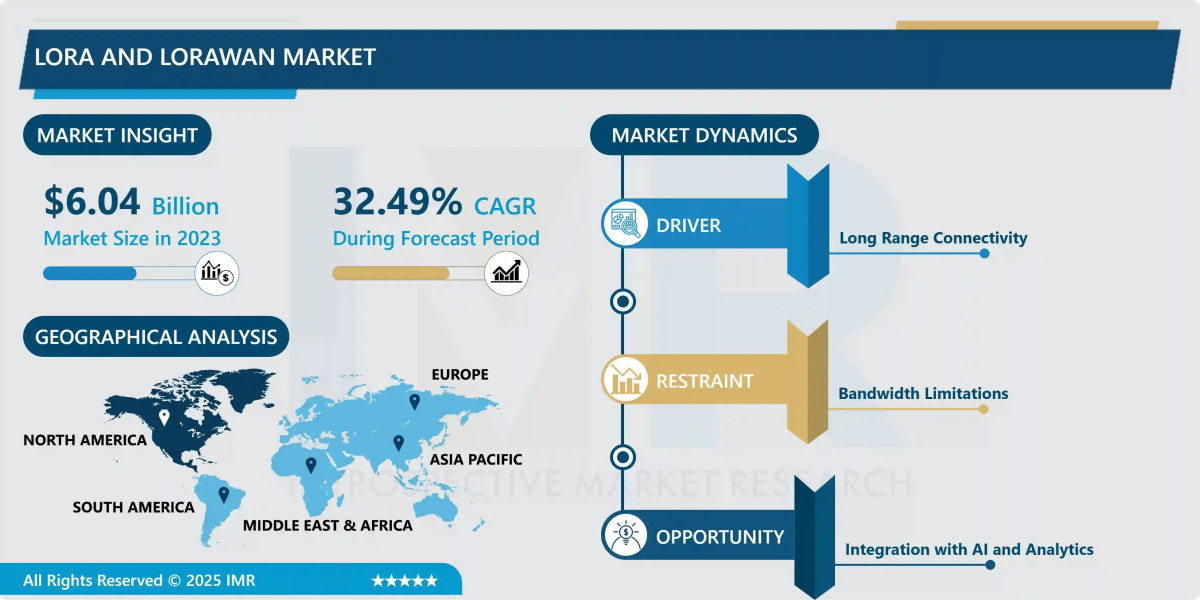

According to a new report published by Introspective Market Research, LoRa and LoRaWAN Market by Offering, Application, and End User, The Global LoRa and LoRaWAN Market Size Was Valued at USD 6.04 Billion in 2023 and is Projected to Reach USD 75.98 Billion by 2032, Growing at a CAGR of 32.49%."
Introduction / Market Overview
The global LoRa and LoRaWAN market is experiencing transformative growth as organizations increasingly adopt these technologies to enable efficient, long-range, and low-power connectivity solutions for Internet of Things (IoT) applications. LoRa (Long Range) is a physical layer modulation technology that facilitates communication over significant distances with minimal power consumption, while LoRaWAN (Long Range Wide Area Network) serves as the communication protocol and network architecture built on this foundation. These complementary technologies have emerged as cornerstones in the IoT ecosystem, distinguished by their unique ability to bridge the gap between compact edge devices and scalable cloud platforms.
Compared to traditional wireless alternatives like cellular networks, Bluetooth, or Wi-Fi, LoRa and LoRaWAN offer distinct advantages, including remarkably low power consumption that allows devices to operate for years on a single battery, extensive coverage reaching up to 15 kilometers in rural areas, and significantly lower deployment costs. These characteristics make them particularly suitable for applications requiring widespread sensor deployment in remote or challenging environments where conventional connectivity solutions prove impractical or cost-prohibitive. The affordability and scalability of LoRaWAN architecture facilitates the deployment of massive IoT networks, accommodating thousands to millions of devices across vast geographic areas.
Major industries embracing these technologies include smart cities, agriculture, healthcare, manufacturing, and logistics. In urban environments, LoRaWAN enables smart parking, waste management, environmental monitoring, and traffic control systems. Agricultural applications leverage the technology for precision farming, livestock monitoring, and soil condition assessment. Healthcare facilities utilize LoRa-based solutions for asset tracking, remote patient monitoring, and equipment management. These diverse implementations underscore the versatility of LoRa and LoRaWAN as foundational connectivity layers empowering the next generation of IoT solutions across the global digital transformation landscape.
Growth Driver
The rising global investment in smart city initiatives represents a primary growth driver for the LoRa and LoRaWAN market. Governments and municipalities worldwide are allocating substantial budgets for IoT infrastructure to address challenges of accelerated urbanization and the necessity for sustainable development. These initiatives encompass diverse technologies designed to enhance urban living through improved transportation systems, efficient energy management, and enhanced public services. LoRa and LoRaWAN technologies have become integral to these smart city ecosystems due to their unique capacity to connect vast numbers of devices over long distances while utilizing minimal power, making them optimal for applications including smart parking, environmental monitoring, asset tracking, and smart metering. The European Union, United States, and Chinese governments have all funded significant LoRaWAN-based smart city projects, with initiatives like Amsterdam's CityFlows project demonstrating practical applications for traffic management, while China's Smart City 3.0 initiative includes plans to deploy over 600,000 LoRaWAN base stations by 2025. As cities globally strive to enhance sustainability and livability, the demand for robust, scalable IoT networks like LoRa and LoRaWAN continues to expand significantly.
Market Opportunity
The accelerating adoption of Industrial IoT (IIoT) applications across diverse sectors presents a substantial market opportunity for LoRa and LoRaWAN technologies. The intersection of IoT with industrial operations represents a burgeoning field with significant potential for innovation and efficiency improvements across manufacturing, utilities, logistics, and agriculture. LoRa and LoRaWAN have become increasingly popular in the IIoT sector due to their cost-effectiveness, minimal power consumption, and long-range communication capabilities, facilitating industrial applications including asset tracking, predictive maintenance, environmental monitoring, and smart metering. As industries increasingly leverage IIoT solutions to enhance operational efficiency, streamline supply chains, and implement predictive maintenance strategies, the demand for scalable and resilient connectivity solutions that can accommodate diverse IoT devices across vast geographic regions continues to grow. The increasing adoption of Industry 4.0 and the strategic networking of connected smart devices to streamline process flows over low-power, cost-effective wide area networks further boosts market potential, particularly as manufacturers seek to optimize production yield, efficiency, and quality through real-time monitoring and control.
The LoRa and LoRaWAN Market is segmented on the basis of Offering, Application, and End User.
Offering
The Offering segment is further classified into Hardware, Platform, and Services. Among these, the Hardware sub-segment accounted for the highest market share in 2023.
The hardware segment's dominance stems from its crucial role as the physical foundation of LoRaWAN networks, encompassing essential components such as sensors, gateways, modules, and end devices. In 2023, hardware captured more than 36.7% of the total market share, driven by increasing demand for low-power, long-range communication solutions critical for diverse IoT applications. The continued expansion of smart cities, agriculture, industrial automation, and environmental monitoring is boosting adoption of these hardware devices. Advancements in hardware technology, including miniaturization of components and more efficient energy management solutions, further strengthen this segment's position. With growing need for sensors and devices that operate for extended periods without frequent maintenance, LoRa-based hardware offers an ideal solution for industries requiring long-range, battery-powered, and cost-effective devices. The hardware segment's significance is expected to persist, with projections indicating it will account for approximately 46.7% of the global LoRaWAN market by 2025.
Application
The Application segment is further classified into Asset Tracking, Industrial IoT, Smart Cities, Smart Agriculture and Livestock Management, Smart Buildings, Smart Healthcare, and Other Applications. Among these, the Asset Tracking sub-segment accounted for the highest market share in 2023.
Asset tracking applications captured more than 23.5% of the total market share in 2023, driven by increasing need for real-time visibility and management of valuable assets across multiple industries. LoRaWAN-based asset tracking solutions provide reliable, cost-effective methods to monitor location, condition, and movement of assets whether in warehouses, transportation networks, or across large outdoor areas. The rise in global trade along with complexity of modern supply chains has further driven demand for these solutions. LoRaWAN's long-range capabilities and low-power requirements make it ideal for tracking goods in transit or remote locations where cellular or GPS-based solutions may be less effective. In healthcare settings specifically, LoRa-based asset tracking solutions offer hospitals powerful tools to enhance operational efficiency and patient care by providing real-time visibility into location and availability of critical resources like beds, medical equipment, and staff. The asset tracking segment benefits from growing trends of digital transformation and automation in industries that rely heavily on managing physical assets.
Some of The Leading/Active Market Players Are-
- The Bosch Group (Germany)
- Cisco (US)
- Orange SA (France)
- Comcast Corporation (US)
- Semtech Corporation (US)
- NEC Corporation (Japan)
- Tata Communications Limited (India)
- Amazon Web Services, Inc. (US)
- Advantech Co., Ltd. (Taiwan)
- Kerlink (France)
- Actility (France)
- Digi International (US)
- MultiTech Systems, Inc. (US)
- Sensoterra (Netherlands)
and other active players.
Key Industry Developments
News 1: In January 2024, LORIOT signed a partnership agreement with SYSCOM to extend the LoRaWAN ecosystem in Latin America.
This strategic partnership enabled both companies to expand their global reach and collaborate on end-to-end solutions, fulfilling the growing demand for IoT solutions in the Latin American region. Such collaborations represent key growth strategies adopted by market players to penetrate emerging markets and address regional connectivity challenges, particularly in areas with developing IoT infrastructure.
News 2: In November 2024, Netmore Group and Vantage Towers announced a strategic partnership aimed at expanding nationwide LoRaWAN connectivity in Portugal.
This collaboration supports digital transformation initiatives for utilities, municipalities, and various organizations, particularly in addressing critical issues like water scarcity. The partnership enhances availability of LoRaWAN connectivity across Portugal, which is essential for deploying Internet of Things applications and demonstrates how infrastructure partnerships accelerate network coverage expansion.
Key Findings of the Study
- The hardware segment dominatesthe offering category, while asset tracking leads application segments, and manufacturing represents the largest end-user vertical.
- North America currently holdsthe largest regional market share, but the Asia-Pacific region demonstrates the fastest growth trajectory.
- Smart city initiatives worldwideand expanding Industrial IoT applications serve as primary growth drivers for market expansion.
- Increasing integration with advanced technologiesincluding AI, machine learning, and 5G networks represents emerging market trends enhancing capabilities.
- Data security concerns and interoperability challengesremain significant restraints affecting broader market adoption.