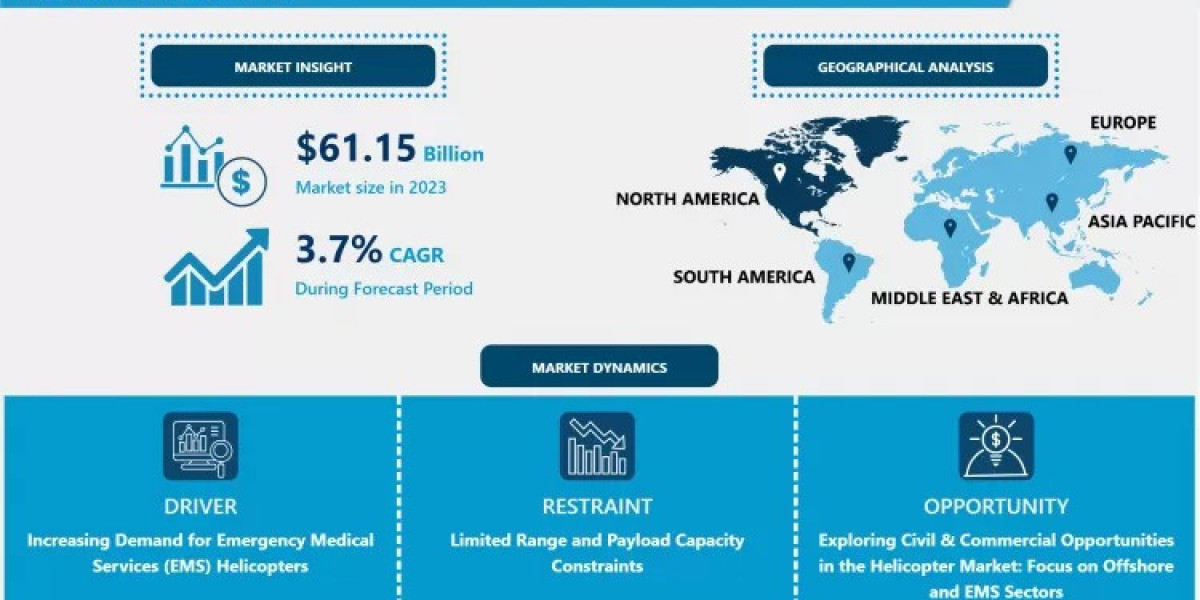

According to a new report published by Introspective Market Research, Helicopter Market by Type, Application, and Component, The Global Helicopter Market Size Was Valued at USD 61.15 Billion in 2023 and is Projected to Reach USD 81.78 Billion by 2032, Growing at a CAGR of 3.70%.
Market Overview
The global helicopter market remains a vital component of the aerospace and defense industry, offering unique vertical take-off and landing (VTOL) capabilities unmatched by fixed-wing aircraft. Helicopters are rotary-wing aircraft that generate lift and thrust from horizontally spinning rotors, providing exceptional maneuverability, the ability to hover, and access to remote or confined areas. Their primary advantages over traditional transportation include operational flexibility without the need for long runways, making them indispensable for missions where time, terrain, or infrastructure are limiting factors. This versatility is the cornerstone of their value across critical sectors.
Growth Driver
The most significant growth driver for the helicopter market is the rapidly expanding demand for Helicopter Emergency Medical Services (HEMS) and search and rescue (SAR) operations globally. The critical need to reduce patient transit time in medical emergencies, often referred to as the "golden hour," is pushing governments and private healthcare providers to establish and expand HEMS networks. Helicopters provide unparalleled access to accident sites, remote areas, and urban centers congested with traffic, directly improving survival rates. Concurrently, increasing frequencies of natural disasters and complex SAR missions in maritime and mountainous regions are driving procurement by coast guards and disaster response agencies. This life-saving imperative is creating consistent, high-value demand for light and medium twin-engine helicopters specifically configured for medical and rescue roles.
Market Opportunity
A substantial market opportunity lies in the development and certification of advanced urban air mobility (UAM) solutions and electric vertical take-off and landing (eVTOL) aircraft. While distinct from traditional helicopters, this evolution represents the next frontier for rotary-wing technology. Major aerospace firms and startups are investing heavily in designing eVTOLs for intra-city passenger transport, cargo delivery, and air taxi services. This nascent sector promises to revolutionize short-haul transportation, alleviating urban congestion. For established helicopter manufacturers, the opportunity involves leveraging their deep expertise in VTOL dynamics, safety certification, and maintenance to develop, partner in, or adapt to this new market. Investing in hybrid-electric and fully electric propulsion technologies now positions companies to lead in the sustainable aviation market of the future.
The Helicopter Market is segmented on the basis of Type, Application, and Component.
Type
The Type segment is further classified into Light, Medium, and Heavy. Among these, the Light Helicopter sub-segment accounted for the highest market share. Light helicopters, typically with a maximum take-off weight (MTOW) of up to 3,100 kg (6,800 lbs), dominate due to their operational versatility, lower acquisition and operating costs, and widespread applicability. They are the workhorses for roles such as pilot training, private charter, law enforcement, news gathering, and single-engine HEMS operations. Their agility, ability to operate from small helipads, and favorable economics for a broad range of civilian operators solidify their position as the most in-demand category globally.
Application
The Application segment is further classified into Civil & Commercial and Military. Among these, the Civil & Commercial segment accounts for a dominant and growing share of the market. This encompasses a vast array of uses including offshore transportation for energy companies, emergency medical services, corporate/VIP travel, tourism, and law enforcement. The growth is fueled by economic development, expansion of offshore wind farms requiring crew transfer, globalization of corporate operations, and the privatization of former state-run SAR and HEMS services. The civil sector's continuous demand for new aircraft and aftermarket services makes it the primary revenue engine for manufacturers.
Some of The Leading/Active Market Players Are-
- Airbus SE (Netherlands/France)
- Leonardo S.p.A. (Italy)
- Boeing Company (USA)
- Lockheed Martin Corporation (Sikorsky) (USA)
- Textron Inc. (Bell Helicopter) (USA)
- Russian Helicopters (Russia)
- Korea Aerospace Industries, Ltd. (South Korea)
- MD Helicopters, Inc. (USA)
- Hindustan Aeronautics Limited (India)
- Robinson Helicopter Company (USA)
- Enstrom Helicopter Corporation (USA)
- Kaman Corporation (USA)
- AVIC Helicopter Co., Ltd. (China)
- “and other active players.”
Key Industry Developments
News 1:
In March 2024, Airbus Helicopters launched the new H160 for the oil and gas market, featuring enhanced safety systems and comfort for offshore crew change operations.
This introduction targets a key revenue segment, offering operators a modern, efficient medium twin-engine helicopter to replace aging fleets, with a focus on reducing operating costs and improving passenger experience on long over-water flights.
News 2:
In February 2024, Boeing and the US Army successfully completed the first flight of the modernized AH-64E Version 6.5 Apache attack helicopter, featuring upgraded software and enhanced maritime capability.
This milestone is part of a critical fleet modernization program, ensuring the platform's combat relevance for decades to come and securing long-term production and sustainment contracts for the military segment.
Key Findings of the Study
- Light Helicopters and the Civil & Commercial application segment are the dominant market drivers.
- North America is the largest regional market, while Asia-Pacific is projected to be the fastest-growing due to increasing defense budgets and civil aviation expansion.
- Growth is primarily driven by the expansion of HEMS/SAR services and ongoing military fleet modernization programs worldwide.
- Key market trends include the integration of advanced avionics and autonomy and the emerging development of hybrid-electric and eVTOL technologies.


