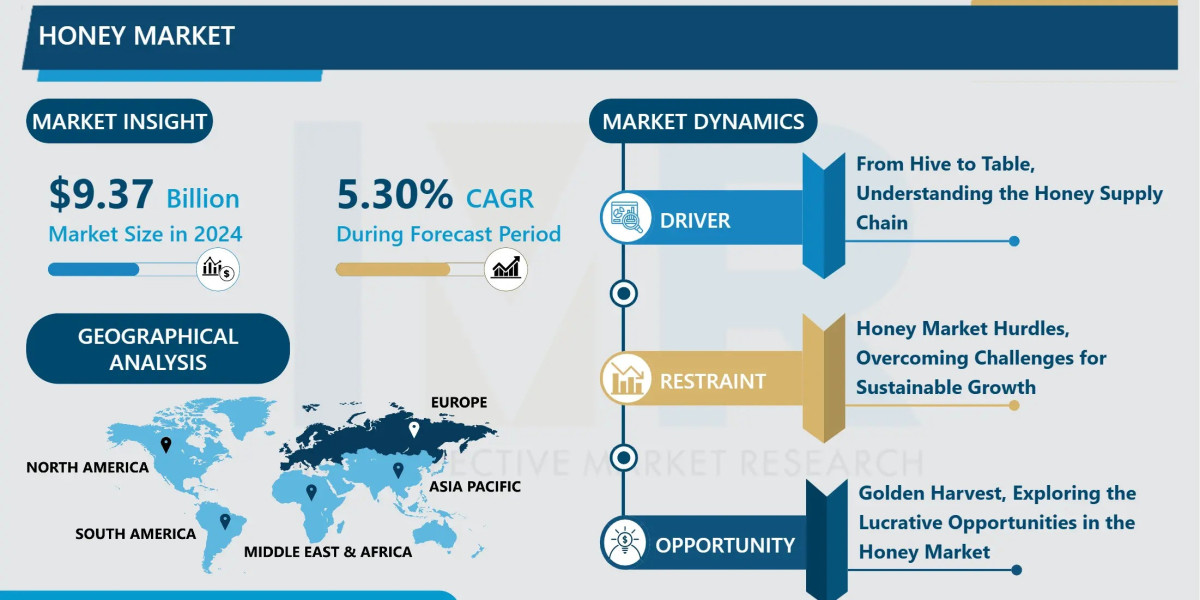

According to a new report published by Introspective Market Research, the Global Honey Market by Product Type, Distribution Channel, and Application, valued at USD 9.37 Billion in 2024, is projected to reach USD 14.16 Billion by 2032, growing at a steady CAGR of 5.30% from 2025 to 2032. This sustained growth is driven by increasing consumer preference for natural and clean-label sweeteners, the rising use of honey in health & wellness products, and its enduring appeal as a traditional food ingredient and home remedy across diverse cultures worldwide.
Honey is a natural, viscous sweetener produced by honey bees from the nectar of flowers. This timeless product offers significant advantages over refined sugar and synthetic sweeteners, including a lower glycemic index, the presence of trace enzymes, antioxidants, vitamins, and minerals, and unique flavors derived from its floral source (monofloral honey). Its versatility and perceived health benefits make it a superior choice not only as a food and beverage sweetener but also as a functional ingredient in nutraceuticals, cosmetics, and pharmaceutical preparations, appealing to health-conscious consumers seeking wholesome, minimally processed alternatives.
A Key Growth Driver: The Global Shift Toward Natural and Clean-Label Ingredients
A primary driver propelling the honey market is the global consumer movement toward natural, clean-label, and less-processed food ingredients. As awareness grows about the potential health drawbacks of excessive refined sugar and artificial sweeteners, consumers are actively seeking healthier alternatives. Honey, perceived as a natural, "pure," and nutrient-containing sweetener, perfectly aligns with this trend. Its use extends beyond the household pantry into packaged food and beverage products, where manufacturers reformulate recipes to replace sugar with honey, leveraging its "natural" marketing appeal. This shift, combined with honey's versatile functional properties (humectant, flavor enhancer, natural preservative), ensures its sustained demand across the food processing industry.
A Key Market Opportunity: Expansion in Nutraceuticals and Functional Food & Beverages
A significant market opportunity lies in the development of honey-based nutraceuticals and its integration into innovative functional food & beverage products. Beyond its role as a sweetener, honey's inherent antibacterial, anti-inflammatory, and antioxidant properties are garnering scientific and commercial interest. This creates opportunities for value-added products such as medicinal honey blends (e.g., with propolis, ginger), honey-based throat lozenges and syrups, and functional beverages (e.g., honey-infused wellness shots, sports drinks). Furthermore, the pairing of specific monofloral honeys (like antioxidant-rich Manuka) with superfoods in snacks and health bars allows brands to command premium pricing and target the fast-growing wellness and preventative health consumer segments.
The Honey Market is segmented on the basis of Product Type, Distribution Channel, and Application.
Application
The Application segment is further classified into Food & Beverages, Personal Care & Cosmetics, Pharmaceuticals, and Others. Among these, the Food & Beverages sub-segment accounted for the highest market share in 2024. Honey's primary use remains in culinary applications, spanning household consumption (spreading, sweetening tea), industrial food processing (bakery goods, breakfast cereals, sauces, dressings), and the beverage industry (alcoholic mead, flavored teas, functional drinks). Its natural sweetness, moisture-retaining properties, and ability to enhance flavor profiles make it a staple ingredient, ensuring this segment's continued dominance in overall market volume and value.
Distribution Channel
The Distribution Channel segment is further classified into Supermarkets/Hypermarkets, Convenience Stores, Online Retail, and Direct Sales. Among these, the Supermarkets/Hypermarkets sub-segment accounted for the highest market share in 2024, as these large-format retail stores are the primary destination for mainstream grocery shopping, offering a wide range of honey brands from economy to premium. However, the Online Retail sub-segment is projected to exhibit a high CAGR. E-commerce platforms are crucial for specialty, organic, and imported monofloral honeys, allowing producers (including small-scale beekeepers) to reach a global audience of discerning consumers who seek specific varieties, authenticity, and detailed product provenance information that may not be available on physical store shelves.
Some of The Leading/Active Market Players Are:
· Capilano Honey Ltd. (Australia)
· Comvita Limited (New Zealand)
· Barkman Honey LLC (USA)
· Dabur India Ltd. (India)
· Billy Bee Honey Products (Canada)
· New Zealand Honey Co. (New Zealand)
· Dutch Gold Honey, Inc. (USA)
· Yamada Bee Company, Inc. (Japan)
· Sioux Honey Association (USA) - (Sue Bee Honey)
· Rowse Honey Ltd. (UK)
· Bee Maid Honey Limited (Canada)
· Nature Nate's (USA)
· Oha Honey (Turkey)
· Manuka Health New Zealand Ltd. (New Zealand)
· Wedderspoon Organic (USA/New Zealand)
and other active players.
Key Industry Developments
News 1: Strategic Investment in Traceability Technology
In October 2024, a leading global honey brand announced a major investment in blockchain-based traceability technology for its supply chain. The initiative aims to provide consumers with verifiable digital proof of origin, authenticity, and organic certification for each jar of honey, combating adulteration.
This move directly addresses a critical challenge in the honey industry—fraudulent labeling and adulteration with sugar syrups. By leveraging technology to ensure transparency, companies can build consumer trust, protect brand integrity, and justify premium pricing for authentic, high-quality products.
News 2: Launch of a Honey-Infused Skincare Line
In June 2024, a major personal care corporation launched a dedicated skincare line centered around Manuka honey and other bee-derived ingredients (propolis, royal jelly). The line highlights honey's natural antibacterial and healing properties for acne-prone and sensitive skin.
This development underscores the expansion of honey from the food aisle into high-margin beauty and personal care. It capitalizes on the clean beauty trend and consumer demand for effective, natural active ingredients, opening a substantial new revenue stream for honey producers and processors.
Key Findings of the Study
· The Food & Beverages application and Supermarkets/Hypermarkets distribution channel dominate global market revenue.
· The Asia-Pacific region is the largest and fastest-growing market, with strong production and consumption in China, India, and Turkey.
· Key growth is driven by demand for natural sweeteners, health & wellness trends, and versatile applications in F&B and personal care.
· Major trends include product premiumization (monofloral, organic), investment in supply chain transparency, and brand storytelling.
· The market is fragmented with a mix of large multinational brands, cooperatives, and numerous small-scale regional producers.


