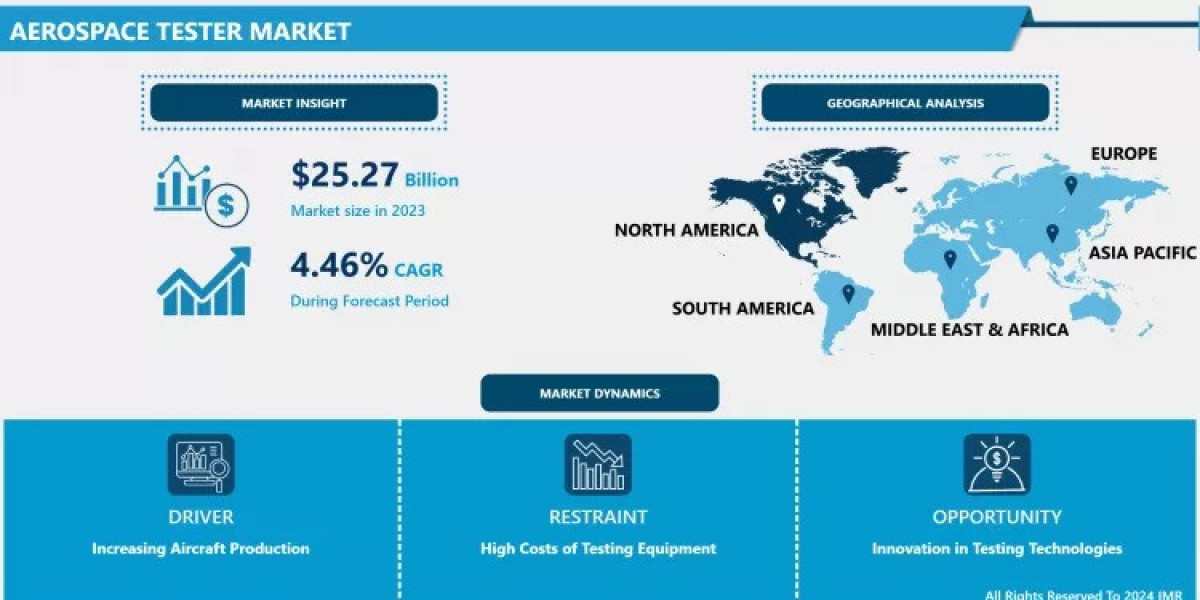

According to a new report published by Introspective Market Research, the Global Aerospace Tester Market by Product Type, Platform, and End-User, valued at USD 25.27 Billion in 2023, is projected to reach USD 37.42 Billion by 2032, growing at a CAGR of 4.46% from 2024 to 2032. This stable expansion is underpinned by the relentless need for safety, reliability, and regulatory compliance in aviation and space sectors, alongside increasing aircraft production rates, fleet modernization, and the growing complexity of avionics and propulsion systems.
Aerospace Testers are specialized equipment and systems used to verify the functionality, performance, and safety of aircraft and spacecraft components, systems, and full assemblies. This encompasses a vast range of equipment from benchtop avionics testers to massive structural test rigs and portable engine analyzers. These tools provide unparalleled precision and reliability compared to manual inspections or less sophisticated methods, enabling engineers to simulate extreme flight conditions, diagnose faults with pinpoint accuracy, and ensure every part meets stringent airworthiness standards before, during, and after service. They are the cornerstone of the industry's "test, fly, certify" philosophy, preventing catastrophic failures and ensuring operational integrity.
A Key Growth Driver: The Surge in Aircraft Production and Fleet Modernization
A primary driver propelling the aerospace tester market is the resurgence in global aircraft production and the ongoing fleet modernization cycle. Major commercial aircraft manufacturers have significant order backlogs for next-generation, fuel-efficient models like the Boeing 737 MAX and Airbus A320neo families. Each new aircraft produced requires comprehensive testing of its airframe, engines, and millions of lines of avionics software. Concurrently, airlines are retrofitting older aircraft with new cabins, connectivity systems, and upgraded avionics, which also necessitates re-testing and certification. This dual demand from new production and in-service upgrades creates a continuous need for both OEM test equipment during manufacturing and portable/stationary testers for MRO facilities, sustaining long-term market growth.
A Key Market Opportunity: The Rise of Automated, Data-Driven, and Portable Testing Solutions
A significant market opportunity lies in the development of next-generation automated, connected, and portable testing solutions. There is a growing demand for testers that can automate repetitive procedures, reduce human error, and generate actionable data insights. This includes systems with advanced diagnostics powered by artificial intelligence (AI) to predict component failures before they occur. Furthermore, the MRO sector strongly favors rugged, portable test equipment that can be used on the flight line or in hangars, minimizing aircraft downtime. Companies that can deliver integrated "smart tester" platforms that combine hardware precision with software intelligence offering faster turnaround times and predictive analytics will capture significant value, especially from cost-conscious airlines and MRO providers.
The Aerospace Tester Market is segmented on the basis of Product Type, Platform, and End-User.
Product Type
The Product Type segment is further classified into Structural Testers, Engine Testers, Avionics & Electrical Testers, Non-Destructive Test (NDT) Equipment, and Others. Among these, the Avionics & Electrical Testers sub-segment accounted for a significant market share in 2023. Modern aircraft are "flying computers," with complex networks of flight control computers, communication/navigation systems, and in-flight entertainment. Ensuring these digital systems function flawlessly is paramount. This segment includes everything from circuit board testers to full aircraft network integration test stands. The increasing software content and electrification of aircraft systems (More Electric Aircraft - MEA) ensure this segment's continued critical importance and growth.
End-User
The End-User segment is further classified into OEMs, MROs, Airlines, and Space Agencies. Among these, the MROs (Maintenance, Repair & Overhaul) sub-segment is a major and stable contributor to market demand. MRO facilities are the lifecycle guardians of aircraft, performing mandatory checks (A, B, C, D), repairs, and component overhauls. Their operations are entirely dependent on accurate test equipment to diagnose issues, verify repairs, and certify airworthiness before an aircraft returns to service. The global growth in air travel expands the active fleet, directly increasing the volume of maintenance events and the corresponding need for reliable test equipment in MRO shops worldwide.
Some of The Leading/Active Market Players Are:
· Honeywell International Inc. (USA)
· Teradyne, Inc. (USA)
· National Instruments Corporation (USA)
· Astronics Corporation (USA)
· Moog Inc. (USA)
· Lockheed Martin Corporation (USA)
· Boeing Company (USA)
· Airbus SE (Netherlands/France)
· L3Harris Technologies, Inc. (USA)
· Safran S.A. (France)
· GE Aerospace (USA)
· Rolls-Royce Holdings plc (UK)
· Curtiss-Wright Corporation (USA)
· Testek, Inc. (USA)
· Intertek Group plc (UK)
and other active players.
Key Industry Developments
News 1: Strategic Partnership for Next-Generation Engine Test Solutions
In October 2024, GE Aerospace and National Instruments announced a collaborative development program for a new suite of intelligent engine test cells. The focus is on integrating real-time sensor analytics and predictive algorithms to optimize test cycles for next-generation sustainable aviation fuel (SAF) and hydrogen-compatible engines.
This partnership underscores the market shift towards intelligent, data-rich testing environments that not only validate performance but also accelerate development cycles for groundbreaking propulsion technologies critical to the industry's decarbonization goals.
News 2: Launch of a Universal Portable Avionics Tester
In June 2024, a leading avionics test company launched a new handheld, multi-function tester designed to service over 95% of common commercial aircraft line-replaceable units (LRUs). The device connects via Wi-Fi, updates its database automatically, and guides technicians through tests with interactive checklists.
This launch addresses the core MRO need for versatility and efficiency. By consolidating many single-purpose testers into one smart, portable unit, it reduces tooling costs, simplifies technician training, and significantly cuts down on aircraft turnaround time for avionics troubleshooting.
Key Findings of the Study
· The Avionics & Electrical Testers product type and the MROs end-user segment are major revenue contributors to the global market.
· North America holds the largest market share due to its concentration of aerospace OEMs and defense spending, while the Asia-Pacific region is expected to register a strong CAGR.
· Key growth is driven by increasing aircraft production, stringent safety regulations, and the growing complexity of aircraft systems.
· Major trends include the digitization and automation of test processes and the development of portable, multi-function test equipment.
· The market features a mix of large, diversified aerospace OEMs, specialized test equipment manufacturers, and engineering service firms.