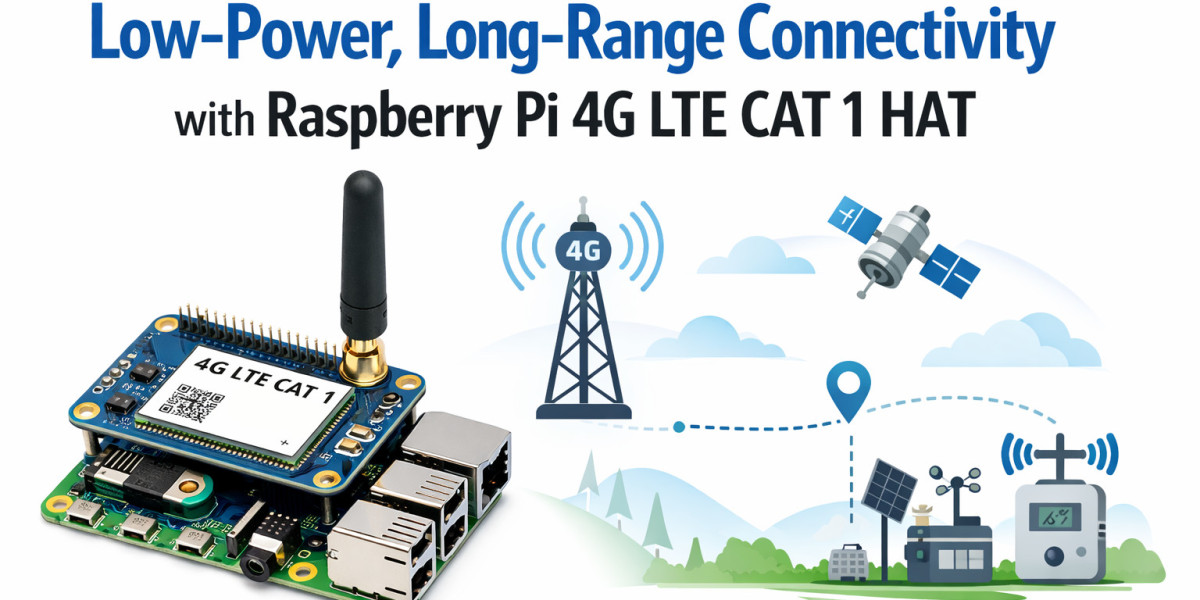

Connectivity is the backbone of modern Internet of Things (IoT) systems. As IoT deployments spread across cities, farms, and remote areas, designers seek reliable links that combine long reach and low power use. One practical solution for many projects is the Raspberry Pi 4G LTE CAT 1 HAT. This accessory gives a Raspberry Pi board direct cellular access, expanding its reach beyond local networks. This article explains how this HAT delivers efficient, long-range connectivity and where it fits best in IoT architectures.
Why Connectivity Matters in IoT
IoT systems must often send data from distant sensors to a central server. The connection type affects:
Range and coverage
Power consumption
Data throughput
Cost of deployment
Different technologies offer different strengths. Wi-Fi works where local networks exist. Low Power Wide Area Networks (LPWAN) like LoRa and NB-IoT save energy but limit speed. Cellular networks cover wide geographical areas with familiar protocols and global reach.
By 2025, analysts expect more than 5 billion cellular IoT connections worldwide, growing about 15 % annually. This growth shows cellular remains central to remote device access, especially for mobile or isolated IoT endpoints. (iot-analytics.com)
What Is the Raspberry Pi 4G LTE CAT 1 HAT?
The Raspberry Pi 4G LTE CAT 1 HAT is a hardware add-on that fits a Raspberry Pi’s GPIO pins. It houses a cellular modem that supports LTE Category 1 (CAT 1) connectivity.
Primary Components
LTE CAT 1 modem (often from Quectel or similar makers)
SIM card slot for a cellular plan
Antenna connectors for better signal strength
USB or UART data interfaces connecting to the Raspberry Pi
Optional GNSS (GPS) module for location data
Compared to USB dongles, the HAT form factor stays compact and uses fewer extra components. The GPIO attach method maintains a tidy build and simplifies power distribution.
Understanding LTE CAT 1 Technology
LTE (Long Term Evolution) includes many categories designed for different uses. CAT 1 sits in a balanced range between high-speed mobile broadband and ultra-low data IoT standards.
Key Technical Limits
Downlink up to ~10 Mbps
Uplink up to ~5 Mbps
Latency generally below 100 ms
These specs suit moderate data tasks like periodic sensor uploads, remote command delivery, and small file transfers. CAT 1 costs less and uses less power than higher LTE categories that focus on high throughput.
Why CAT 1 for IoT
CAT 1 works well when you need:
More data than NB-IoT or LoRa can provide
Lower power than high-speed LTE
Stable, wide coverage across cellular networks
Support for full IP connectivity and standard TCP/UDP stacks
These strengths position CAT 1 as a practical choice for connected sensors and gateways that must communicate reliably over distance.
Long-Range Connectivity Features
Long-range connectivity means maintaining communication over wide areas. Cellular networks provide that reach by design.
1. Global Network Coverage
Major carriers support 4G LTE across urban, suburban, and rural regions. In many markets, carrier coverage passes 90 % of populated areas. This coverage gives IoT devices access far beyond the reach of Wi-Fi or localized networks.
2. Mobility and Handover
CAT 1 supports handover between towers. Devices in motion — like vehicles or asset trackers — maintain connections as they move. This behavior suits telemetry and telematics.
3. Signal Penetration
Cellular signals often penetrate built environments better than Wi-Fi. Underground sites, factory floors, and remote outposts can still connect via LTE networks.
Power Considerations in IoT Connectivity
Low power use remains critical in IoT systems. Devices that depend on batteries should minimize consumption to stay deployed longer.
1. Power in Cellular Modems
In absolute terms, cellular modems consume more power than minimal LPWAN radios. However, CAT 1 modules still scale power with activity. They use:
Idle modes that draw minimal current when not transmitting
Sleep or standby states between data bursts
Designers can reduce total energy use by limiting active connection time and batching data transfers.
2. Comparison to Other IoT Technologies
Technology | Typical Range | Typical Power Use | Data Rate | Best Fit |
Wi-Fi | ~50–100 m | Low | High | Local networks |
LoRa | ~2–15 km | Very low | Very low | Sparse telemetry |
NB-IoT | ~1–10 km | Very low | Low | Small bursts |
LTE CAT 1 | Nationwide | Moderate | Moderate | Broadband IoT |
LTE CAT 1 sits in the moderate range. It uses more power than LPWAN systems but gives higher throughput and global reach.
Where the HAT Fits Best in IoT Projects
The Raspberry Pi 4G LTE CAT 1 HAT can be ideal in specific scenarios.
1. Remote Sensor Hubs
If sensors sit far from networks, the HAT can provide connectivity. For example, a remote weather station can send hourly logs to a central server without local infrastructure.
2. Mobile and Distributed Devices
Vehicles, shipping containers, and mobile devices benefit from cellular reach. CAT 1 supports handover and offers standard networking stacks that simplify remote access.
3. Industrial Gateways
Factories often use gateways to collect data from local sensors and upload it to the cloud. The HAT provides an independent backhaul that avoids wired networks.
4. Backup Connectivity
When a primary link fails, a cellular backup keeps the system online. A Raspberry Pi with the HAT can switch to cellular communication automatically when needed.
Technical Benefits of Cellular Integration
A cellular HAT adds useful features beyond connection.
1. Standard IP Networking
Cellular support gives IP connectivity similar to Ethernet or Wi-Fi. Devices can use standard protocols (MQTT, HTTP, TCP/UDP) without proprietary steps.
2. Security Protocol Support
Cellular modems support secure protocols like TLS. This capability helps protect data in transit.
3. Multi-Carrier Support
Many HATs support multiple frequency bands. This design lets a single device work across regions or carriers with the correct SIM plan.
4. Remote Management
With global reach, devices can receive remote updates and diagnostics without physical access.
Cost and Data Planning
Connectivity solutions must balance cost with performance.
1. Hardware Costs
A Raspberry Pi 4G LTE CAT 1 HAT typically sells in the range of a few thousand Indian rupees. In addition, you need:
A Raspberry Pi board
Cellular data subscription
Antennas and protective enclosure
These form the base hardware cost for a connected IoT node.
2. Data Plan Costs
Cellular data pricing varies by region. Many carriers offer IoT-focused plans with small monthly allowances. Because many IoT devices only send periodic updates, a 500 MB to 1 GB monthly plan can suffice in many use cases.
Examples of Real Use Cases
1. Wildlife Monitoring Station
A remote station collects environmental data and sends daily aggregates. The HAT gives a reliable path even where no Wi-Fi exists.
2. Fleet Telematics System
Vehicles log GPS and engine status, then upload data every few minutes. CAT 1’s balanced throughput handles telemetry smoothly.
3. Agricultural Sensor Grid
Distributed soil moisture sensors report data at intervals. A cell-connected Raspberry Pi aggregates data from field nodes and sends it to a central server.
4. Remote Pump Control
A water pump monitors reservoir levels and reports status. The HAT gives both telemetry and remote command control.
These examples show how long reach and reliable links support real tasks.
Power Strategies for Cellular IoT with HATs
Even with good connectivity, power remains a challenge. Here are strategies to lower energy use:
1. Duty Cycling
Run the modem only when needed. Turn it off between transmissions.
2. Batch Data Transfers
Collect data for a set period and send it in one burst.
3. Use Sleep Modes
Configure the modem and Raspberry Pi to use sleep states when idle.
4. Use Efficient Power Supplies
Design power circuits to reduce losses and waste.
Combining cellular access with careful power management extends device life.
Technical Challenges and Mitigations
No solution is perfect. The HAT brings strong reach but also requires attention to design.
1. Network Availability
Cellular coverage can vary. Use surveys and carrier maps to pick the right provider.
2. SIM and Carrier Setup
Getting IoT SIM plans and correct APNs set up can take time. Plan this at design stage.
3. Signal Quality
Antenna placement matters. Place antennas where the signal is strongest.
4. Firmware and Software
Modem firmware updates and network stacks need management. Test updates before wide deployment.
Proper engineering choices reduce these risks.
Comparison to Alternative Connectivity Options
Feature | Wi-Fi | LPWAN | NB-IoT | LTE CAT 1 HAT |
Range | Short | Very long | Long | Nationwide |
Data Rate | High | Low | Low | Moderate |
Power | Low | Very low | Very low | Moderate |
Mobility | Limited | Yes | Yes | Yes |
Standard Protocols | Yes | Limited | Limited | Yes |
This table shows how each technology fits specific needs. The HAT sits between macro cellular and local/low-power options.
Conclusion
The Raspberry Pi 4G LTE CAT 1 HAT offers a practical path to low-power, long-range connectivity for many IoT projects. It balances moderate power use with broad geographic reach and reliable IP networking. It works well in mobile, remote, and industrial environments. Careful data planning and power strategies make it efficient.
If your project requires reliable links where local networks fail, or must operate over large distances, the Raspberry Pi with a cellular HAT is a strong technical choice.