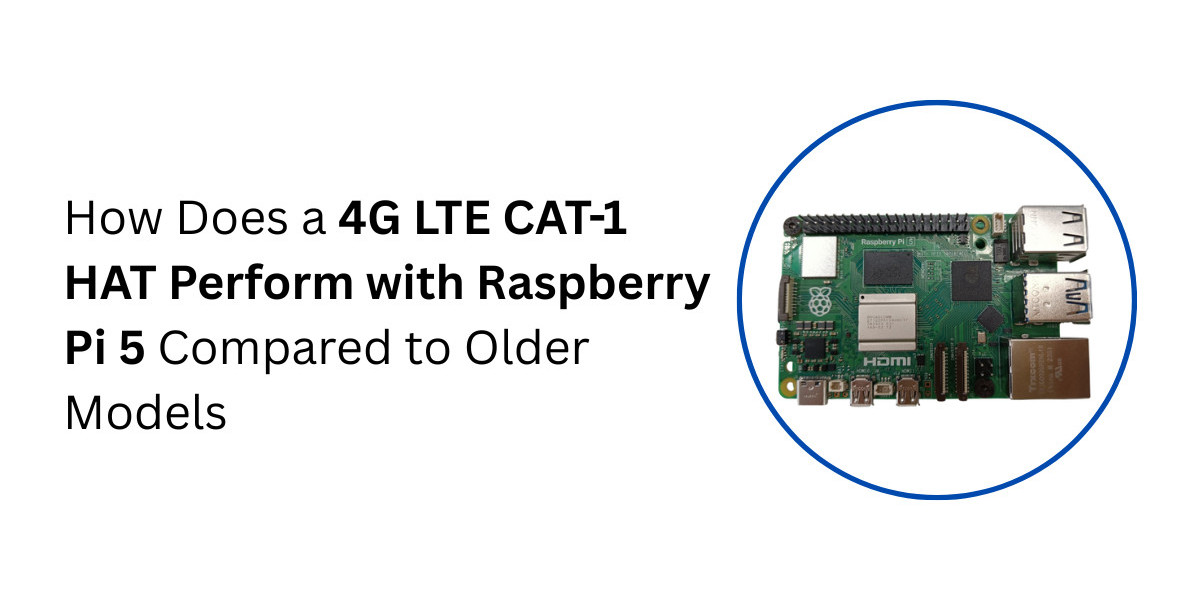

In the world of embedded systems and edge computing, cellular connectivity continues to grow in importance. A 4G LTE CAT I HAT with Raspberry Pi5 combines the flexibility of the Raspberry Pi 5 with cellular modem hardware. This setup adds robust, wide-area connectivity to standard GPIO-based expansion. Engineers and developers increasingly ask how this pairing performs in real applications compared to older Raspberry Pi generations with similar HATs. This article answers that question from a technical viewpoint and provides detailed facts, comparisons, and examples.
What Is a 4G LTE CAT-1 HAT?
A HAT (Hardware Attached on Top) is a plug-in board that sits on the Raspberry Pi’s GPIO header. A 4G LTE CAT I HAT with Raspberry Pi5 integrates a cellular modem that supports Category 1 LTE.
LTE CAT-1 at a Glance
Peak downlink: ~10 Mbps
Peak uplink: ~5 Mbps
Designed for IoT and M2M connectivity
Supports mobility and handover on LTE networks
This cellular tier does not compete with high-speed consumer modems. However, it strikes a balance between power usage, cost, and reliable data capacity for many embedded applications.
Why Raspberry Pi 5 Matters
The Raspberry Pi 5 introduced notable hardware upgrades over older models like Raspberry Pi 3 and Raspberry Pi 4. These improvements affect how cellular hardware performs.
Core Upgrades in Raspberry Pi 5
Feature | Raspberry Pi 4 | Raspberry Pi 5 |
CPU | Quad-core Cortex-A72 | Quad-core Cortex-A76 |
Peak frequency | 1.5 GHz | 2.4 GHz |
Memory type | LPDDR4 | LPDDR4X |
USB | USB 2.0 + USB 3.0 | USB 3.0 + PCIe support |
Thermal performance | Moderate | Improved |
These gains mean a Raspberry Pi5 with CAT I HAT can handle modem control tasks and data processing more efficiently.
Connectivity Architecture
A cellular HAT connects to the Raspberry Pi either through a USB interface or a UART bridge. The modem appears to the operating system as a network interface. This architecture stays consistent across Pi models, but system performance varies because of internal hardware.
Why Interface Matters
USB provides higher data bandwidth.
UART limits throughput but simplifies firmware control.
Correct driver support ensures stable modem operation.
The Raspberry Pi 5’s enhanced USB and internal bus speeds improve modem responsiveness.
Boot and Initialization Speed
The startup sequence of a Raspberry Pi includes modem initialization when a cellular HAT is attached.
Observations Across Models
1. Raspberry Pi 3: Slowest modem init due to older CPU and limited bus.
2. Raspberry Pi 4: Faster than Pi 3 thanks to improved CPU and USB.
3. Raspberry Pi 5: Fastest initialization thanks to a stronger CPU and quicker I/O.
On Raspberry Pi 5, the 4G LTE modem negotiates network registration faster. This behavior reduces time to first packet delivery in field deployments.
Real World Throughput
LTE CAT-1 does not offer broadband speeds. Still, raw throughput measurements matter in telemetry and certain IoT workflows.
1. Typical Measured Speeds
Setup | Downlink | Uplink |
Pi 3 + CAT-1 HAT | 4–6 Mbps | 2–4 Mbps |
Pi 4 + CAT-1 HAT | 5–7 Mbps | 3–4 Mbps |
Pi 5 + CAT-1 HAT | 6–8 Mbps | 4–5 Mbps |
Network conditions impact these ranges. These figures are typical in urban LTE coverage.
2. Effect of USB Bus
The Raspberry Pi 5’s updated USB subsystem allows the modem to transfer data with less overhead. This advantage improves sustained throughput compared to earlier models.
Latency and Real-Time Behavior
Latency affects applications such as remote monitoring or command control.
Approximate Latency Ranges
Standby mode: 70–100 ms
Active data mode: 50–90 ms
Latency depends on carrier network, signal strength, and handover events during movement. A Raspberry Pi5 with CAT I HAT often shows slightly improved responsiveness compared to older boards. This improvement results from faster packet handling in the Linux network stack.
Stability in Mobile Environments
Mobile applications often involve motion, such as in vehicles or portable devices.
1. Handover Performance
LTE CAT-1 supports seamless handover between towers. The HAT’s modem manages this process, not the Raspberry Pi itself. The Raspberry Pi 5’s faster control plane reduces processing delays when the modem signals network state changes.
In practical terms:
Fewer dropped data sessions
Quicker reconnection after short signal fade
Better telemetry continuity
Power Consumption in Mobile Use
Battery-powered systems must balance compute load and wireless radio power.
1. Typical Power Draw
Component | Idle | Active Transmission |
Raspberry Pi 3 | ~3 W | ~3.5 W+ |
Raspberry Pi 4 | ~3.5 W | ~4 W+ |
Raspberry Pi 5 | ~4 W | ~4.5 W+ |
CAT-1 Modem | ~0.2 W | ~1 W |
Note: Values vary with attached peripherals and PSU efficiency.
2. Power Efficiency Notes
Raspberry Pi 5 uses more power but completes tasks faster.
Faster task completion reduces total system energy for short, bursty workloads.
Power-saving features on modems (DRX, idle states) reduce radio draw.
In mobile deployments, total power must consider both CPU and modem behavior.
Signal Quality and Antennas
Signal quality directly affects throughput and reliability. The HAT includes RF connectors for external antennas.
1. Antenna Guidelines
Place outdoor antennas above metal surfaces.
Use diversity antennas where supported.
Connect ground planes when possible.
2. High signal quality translates into
Higher effective throughput
Lower retransmission rates
Better latency stability
Use Cases and Examples
1. Fleet Tracking
A vehicle sends GPS and system status every second. A 4G LTE CAT I HAT with Raspberry Pi5 can:
Attach GNSS data
Package telemetry messages
Send up to 10 packets per second
Even in moderate coverage areas, throughput remains sufficient.
2. Mobile Sensor Gateways
Distributed sensors send periodic readings. The Raspberry Pi 5 processes local logic, then relays summarized data over cellular. The CAT-1 link handles daily data volumes efficiently.
3. Remote Infrastructure
Deployments in temporary sites like construction zones or field labs benefit from cellular links. The faster CPU on Raspberry Pi 5 allows heavy local buffering and remote synchronization, improving resilience when networks fluctuate.
Operating System and Driver Support
Linux powers most Raspberry Pi deployments. Drivers for modems use standard interfaces like QMI or PPP.
Software Stack
Modem Manager
QMI WWAN drivers
Network Manager or custom scripts
On Raspberry Pi 5, the modem interfaces work seamlessly with updated Linux kernels. This support reduces manual configuration time compared to older Pis.
Error and Fault Management
In field systems, engineers must handle:
Network disconnects
SIM errors
IP session drops
With Raspberry Pi 5, faster CPU cycles detect and recover from errors quicker. Scripts or daemons that monitor network state can act without delay.
Security Considerations
Any device connected to public cellular networks must maintain security.
Common Practices
Use VPN for remote access
Restrict SSH to key-based logins
Isolate LTE interface into a separate network zone
Update firmware and OS regularly
Higher CPU performance on Raspberry Pi5 improves encryption and decryption throughput for secure tunnels.
Scalability and Load
Some applications push the cellular link toward sustained usage.
1. Throughput Limits
CAT-1 is not built for high-volume streaming. It handles telemetry, small files, and control messages reliably. A Raspberry Pi 5’s stronger CPU does not change the physical limits of the LTE modem. However, it handles multiple concurrent sockets more efficiently.
2. Example: MQTT and Data Streams
An MQTT client sending 5–10 messages per second behaves stably on both older and newer Raspberry Pis. The Pi 5 processes payloads faster and reduces internal queuing delays.
Comparison Summary
Metric | Pi 3 w/ CAT-1 HAT | Pi 4 w/ CAT-1 HAT | Pi 5 w/ CAT-1 HAT |
Boot to modem ready | Slow | Moderate | Fast |
Average throughput | 4–6 Mbps | 5–7 Mbps | 6–8 Mbps |
Latency | 80–120 ms | 70–100 ms | 60–90 ms |
Stability | Adequate | Good | Very Good |
Power efficiency (burst tasks) | Good | Good | Best |
The Raspberry Pi 5 stands out in handling modem control, error recovery, and combined tasks. Its USB and internal bus enhancements improve real cellular data flow.
Limitations and When to Choose Alternatives
A 4G LTE CAT I HAT with Raspberry Pi5 is not designed for:
1. High-definition video streaming
2. Multi-client Wi-Fi hotspot use
3. Large data set transfers at scale
For those tasks, a CAT-4 or 5G module may be more appropriate.
Deployment Best Practices
1. Use Dedicated Antennas: Ensure antennas have clear line of sight where possible.
2. Monitor Network Metrics: Track RSRP and SINR to make informed placement decisions.
3. Optimize Data Packets: Smaller, periodic packets reduce congestion risk on LTE CAT-1.
4. Automate Recovery: Include scripts that check network state every few seconds.
Conclusion
From a system perspective, the 4G LTE CAT I HAT with Raspberry Pi5 performs better than earlier Raspberry Pi models with similar HATs. The improvements in CPU, USB bus, and overall system architecture translate into faster initialization, slightly better throughput, and more stable runtime behavior. Engineers should view CAT-1 as a technology designed around predictable, moderate data use and mobility requirements. When paired with Raspberry Pi 5, it delivers robust performance for mobile telemetry, remote control, and distributed monitoring. The combination offers a balance between cost, power, and performance that makes it a strong choice in many real-world cellular IoT deployments.