
Executive Summary:
The Global Grain Silos and Storage System Market is a foundational sector within the agriculture and infrastructure industries, focused on providing secure, long-term storage solutions to minimize post-harvest losses and ensure global food security. The market includes manufacturing and deployment of various silo types, handling equipment, and integrated monitoring systems.
Growth is primarily driven by the need to mitigate huge post-harvest losses (estimated at up to 20% in some developing regions), rapid modernization of agricultural infrastructure, and strong government initiatives to build strategic grain reserves. Flat Bottom Silos remain the largest product segment, while the integration of IoT and monitoring systems represents the key growth trend. Asia-Pacific is the largest and fastest-growing regional market, fueled by major government investments in China and India.
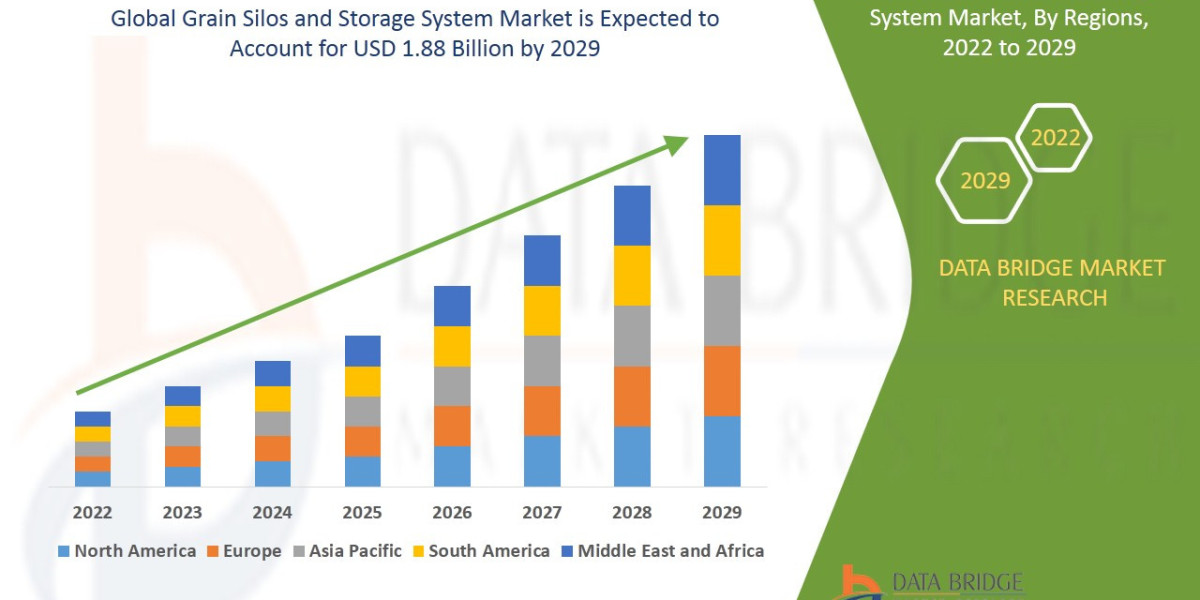
Data Bridge Market Research analyses that the grain silos and storage system market will project a compound annual growth rate (CAGR) of 5.10% during the forecast period of 2022-2029 and is likely to reach the USD 1.88 billion by 2029.
Industry Overview: Segmentation and Product Types
The market is segmented by the physical design of the silo, the construction material, and the scale of the operation (on-farm vs. commercial/terminal storage).
Market Size and Growth Metrics (Estimated Range)
| Metric | Estimated Value (2024) | Projected CAGR | Forecast Period |
| Market Value (Current) | $\approx$ USD 1.75 Billion – 2.0 Billion | - | - |
| Projected CAGR | $\approx$ 4.7% – 5.6% | (Average) | Through 2033-2035 |
| Dominant Silo Type | Flat Bottom Silos | - |
Key Market Segmentation
| Segmentation | Dominant Sub-Segment | Key Drivers |
| By Silo Type | Flat Bottom Silos | Ideal for high-capacity, long-term commercial storage; largest revenue share. |
| By Material | Steel Silos | Durability, standardization, and suitability for mass production; largest share. |
| By Storage Capacity | Above 5,000 Tons | Driven by terminal elevators and government strategic reserves. |
| By Grain Type | Wheat and Maize | Highest global production and consumption volumes. |
| By End-User | On-Farm Storage | Growing need for farmers to manage inventory for price arbitrage; highest volume. |
| By Region | Asia-Pacific | Huge agricultural output and government infrastructure initiatives. |
Analysis: Drivers, Challenges, and Emerging Trends
Key Market Drivers
Minimizing Post-Harvest Losses: The most significant driver is the urgent need to combat massive post-harvest losses caused by pests, moisture, and spoilage in traditional storage, which can be dramatically reduced by modern, hermetically sealed silos.
Global Food Security and Population Growth: A rapidly increasing global population and the threat of climate-induced crop volatility compel governments and commercial operators to invest in robust, long-term storage infrastructure to maintain strategic food reserves.
Government Support and Subsidies: Major agricultural economies (e.g., US, Canada, India, China) often provide financial incentives, subsidies, and large public tenders for the construction of modern silo complexes to upgrade logistics and storage networks.
Modernization of Agriculture: The global shift toward large-scale, commercial farming and automated handling necessitates high-capacity, integrated storage systems compatible with modern material handling machinery.
https://www.databridgemarketresearch.com/reports/global-grain-silos-and-storage-system-market
Market Challenges and Restraints
High Initial Capital Investment: The substantial upfront cost of equipment, construction, and installation, particularly for large, automated steel or concrete silos, is a major barrier for small-scale farmers and developing economies.
Safety Risks: Grain storage silos pose serious safety hazards, including engulfment (inflow of grain) and dust explosions, requiring continuous training, compliance with stringent regulations (e.g., OSHA standards), and sophisticated safety systems.
Maintenance and Operational Costs: Silos require ongoing costs for aeration, pest control, and structural integrity checks, which can be burdensome, especially if the facility is not utilized at full capacity.
Competition from Alternative Storage: While less secure, low-cost alternatives like temporary bag silos and bunkers still absorb a portion of the market, particularly in short-term storage and high-volume harvest seasons.
Emerging Market Trends
Smart Silos and IoT Integration: The leading trend is the adoption of smart storage systems. Silos are being fitted with IoT sensors for real-time, remote monitoring of temperature, moisture, and $\text{CO}_2$ levels, enabling predictive maintenance and preventing spoilage through automated aeration.
Modular and Prefabricated Solutions: There is increasing demand for prefabricated, modular silos (especially aluminum and corrugated steel) that offer quicker installation, scalability, and easier relocation, appealing to smaller commercial operations and decentralized storage needs.
Sustainable Materials: Research is focused on developing eco-friendly and composite materials (e.g., specialized plastics, fiber-reinforced materials) that offer superior moisture and pest resistance with a lower carbon footprint than traditional steel or concrete.
Increased Demand for Hopper Silos: Though flat bottom silos lead in volume, hopper bottom silos are seeing faster growth due to their ability to allow gravity-assisted, near-complete unloading, which is preferred by feed mills and processing plants that prioritize fast, clean turnover.
Future Outlook: Digitalization and Diversification
The future of the Grain Silos and Storage System Market is one of necessary modernization, driven by technology and sustainability mandates to protect a volatile global food supply.
Technology Investment: Continued high R&D spending will focus on integrating AI and machine learning with IoT sensor data for automated, optimal storage condition management and predictive quality control.
Infrastructure Boom in Emerging Markets: The largest volume growth will be realized in the Asia-Pacific and Africa regions, where rapid urbanization and government commitments to food self-sufficiency drive the replacement of traditional storage with modern metal silos.
Holistic Service Offerings: Manufacturers are shifting from being mere product suppliers to offering integrated storage system solutions, including material handling, drying, aeration, software, and maintenance services, securing long-term revenue streams.
Browse More Reports:
Global Agricultural Soil Wetting Agents Market
Global Eye Tracking and Vision Therapy Systems Market
Europe Infusion Pump System, Accessories and Software Market
Indonesia Zeolite Market
Europe Wheat Gluten Market
Europe Walk-In Refrigerators and Freezers Market
Asia-Pacific Track and Trace Solutions Market
North America Track and Trace Solution Market
Europe Session Initiation Protocol (SIP) Trunking Services Market
North America Radiofrequency (RF) Microneedling Market
Middle East and Africa Predictive Maintenance Market
North America Predictive Maintenance Market
Asia-Pacific Mass Spectrometry Market
Europe Mass Spectrometry Market
Europe Hepatitis Delta Virus (HDV) Infection Market
Conclusion
The Global Grain Silos and Storage System Market is a robust and essential pillar of global commerce and agriculture. Its trajectory is firmly upward, propelled by the fundamental need to feed a growing population and the strategic imperative to mitigate massive food waste. The future will belong to companies that successfully integrate digital intelligence into their physical products, providing not just safe containment, but also real-time, optimized preservation of the world's most critical crops.
Contact Us:
Data Bridge Market Research
US: +1 614 591 3140
UK: +44 845 154 9652
APAC : +653 1251 975
Email:- corporatesales@databridgemarketresearch.com