
Modern industrial machines are becoming more compact. At the same time, they must operate at higher speeds and handle heavier loads. This creates a challenge: how to maintain structural rigidity without increasing machine size.
Common problems in compact systems include:
Insufficient rigidity under moment load
Vibration during rotation
Complex multi-bearing assemblies
Alignment errors during installation
Increased maintenance frequency
In robotics and automation, even small positioning errors can affect production accuracy. Manufacturers need a bearing solution that delivers strength, precision, and compact integration.
Weaknesses in Traditional Bearing Designs
Traditional setups often combine separate radial and thrust bearings to handle different load directions. While functional, this approach has disadvantages:
Larger installation space
Higher assembly complexity
Greater risk of misalignment
Reduced overall stiffness
Over time, these issues can lead to uneven wear and reduced equipment lifespan.
The Solution – What Is an RA Cross Roller Bearing?
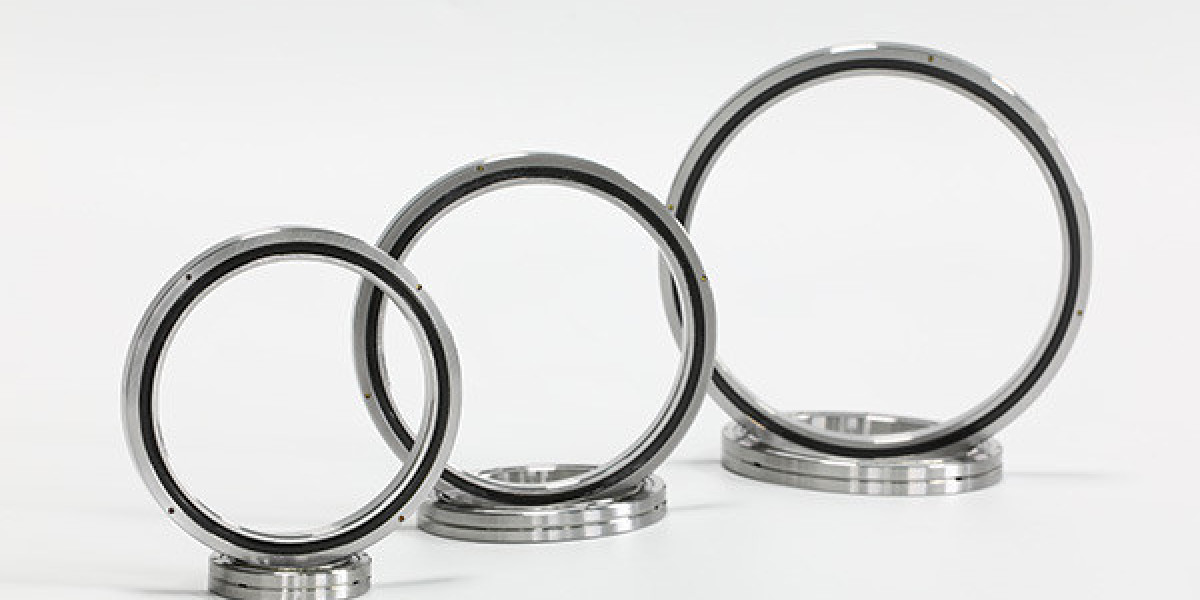
The RA cross roller bearing is a compact cross roller bearing with a separable outer ring structure. It is designed for applications where space is limited but high rigidity is required.
Its slim design reduces installation size while maintaining the ability to handle:
Radial loads
Axial loads (both directions)
Moment loads
This makes it ideal for precision rotary systems.
How It Works
Inside the bearing, cylindrical rollers are arranged alternately at 90 degrees. This cross arrangement allows multi-directional load support within a single bearing.
Working advantages include:
Even force distribution
Increased contact surface
Reduced deformation under load
High rotational accuracy
The separable outer ring design simplifies installation and improves mounting flexibility.
By combining compact size with high rigidity, RA cross roller bearings improve machine performance without increasing structural weight.
Key Features That Improve Performance
RA cross roller bearings are engineered for demanding precision applications.
Core Advantages
Slim and lightweight structure
High rigidity under moment load
Excellent rotational accuracy
Smooth and stable motion
Easy mounting design
Reduced friction torque
These features help manufacturers:
Save installation space
Improve positioning accuracy
Reduce vibration
Extend service life
Simplify system design
For OEM manufacturers, compact solutions are essential to remain competitive in automation markets.
Comparison with Other Bearing Types
| Feature | RA Cross Roller Bearing | RU Cross Roller Bearing | Traditional Ball Bearing |
|---|---|---|---|
| Structure | Separable outer ring | Integrated inner & outer ring | Standard radial design |
| Load Handling | Multi-directional | Multi-directional | Mainly radial |
| Space Efficiency | Very Compact | Compact | Moderate |
| Installation Flexibility | High | Very High | Standard |
| Precision Level | Excellent | Excellent | Moderate |
RA type offers flexibility and compact design, while RU type focuses on integrated rigidity. Both outperform traditional radial bearings in precision applications.
Real Industrial Applications
RA cross roller bearings are widely used in precision industries.
Common Applications
Industrial robot joints
CNC rotary tables
Indexing equipment
Semiconductor machinery
Medical diagnostic devices
Automated inspection systems
In robotic joints, they support smooth arm movement with high moment stiffness.
In CNC rotary tables, they maintain stable rotation under cutting forces.
In semiconductor equipment, high accuracy ensures production quality.
These industries demand reliability and consistent performance.
Why Manufacturers Prefer RA Cross Roller Bearings
B2B buyers prioritize performance consistency and long-term durability.
RA cross roller bearings provide:
High rigidity in limited space
Reduced system complexity
Accurate motion control
Lower vibration levels
Longer maintenance intervals
For automation system manufacturers, precision and compact integration reduce overall machine size and improve efficiency.
In competitive markets, equipment accuracy directly impacts customer satisfaction.
How to Select the Right RA Cross Roller Bearing
Choosing the correct bearing requires careful technical evaluation.
Key Selection Factors
Maximum radial and axial loads
Required moment load capacity
Installation space constraints
Desired rotational accuracy
Mounting configuration
Operating speed
Environmental conditions
Proper preload selection is also critical to ensure rigidity and long-term stability.
Working with an experienced bearing supplier ensures correct model selection and optimal system performance.
Conclusion
As industrial systems evolve, compact design and precision become more important. Traditional bearing solutions often increase structural size or reduce rigidity.
RA cross roller bearings provide a balanced solution by combining slim structure, high load capacity, and excellent rotational accuracy. Their separable outer ring design adds flexibility while maintaining stiffness.
For robotics, CNC equipment, and automation systems, investing in high-performance cross roller technology improves reliability, reduces downtime, and supports long-term industrial success.


